
New Master Course “Technologies in Radiotherapy”
The course Technologies in Radiotherapy introduces students to the physics, biology, and clinical workflow of modern radiation therapy. It is designed to provide a broad foundation in radiotherapy technologies, from fundamental beam interactions to advanced treatment modalities such as adaptive therapy and FLASH.
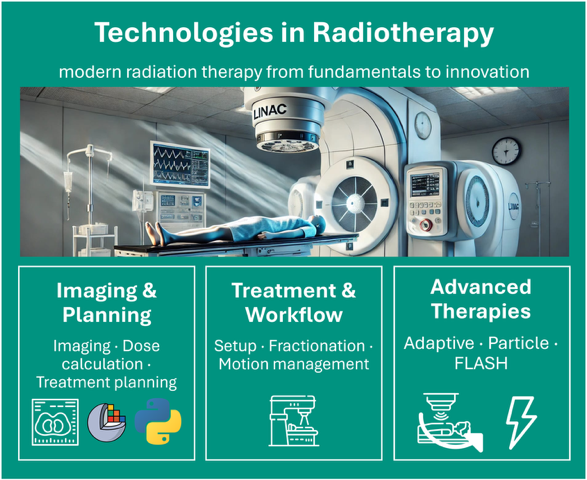 The course is divided into three main parts:
- Fundamentals of radiotherapy – beams and accelerators, radiobiology, clinical workflow, and patient set-up.
- Treatment planning systems – algorithms for dose calculation, imaging integration, and hands-on introduction to software such as 3D.
- Emerging technologies and clinical translation (seminar sessions) – adaptive radiotherapy, advanced machine, advanced particle therapy, synthetic CT, and FLASH radiotherapy.
Schedule for Summer Semester 26:
- Weekly lecture on Thursdays 11:30–13:00, Room 30.34.SR LTI.
- Practical sessions (dates to be arranged).
- The course will probably include an excursion to a radiotherapy facility.
- Independent seminar sessions (Emerging technologies and clinical translation from July onwards) with required attendance for two of them.
Evaluation:
- 50% written exam
- 50% group project (individual presentation)
Language:
- English
Course coordination by Prof. Francesca Spadea aided by PhD. Alexander Pryanichnikov and MSc. Joana Leitão, with invited speakers for different sessions.
The course is limited to maximum 30 students where the priority is given to:
1) Biomedical Engineering Master students.
2) ETIT Master students with specialization in Biomedical Engineering.
3) ETIT and Computer Science Master Students who have attended some course in medical imaging.
4) Master students of other disciplines with strong interest in medical images.
Recommended skills:
- Basic knowledge in particle physics, medical physics, biology, or medical imaging.
- Interest in computational tools and teamwork.